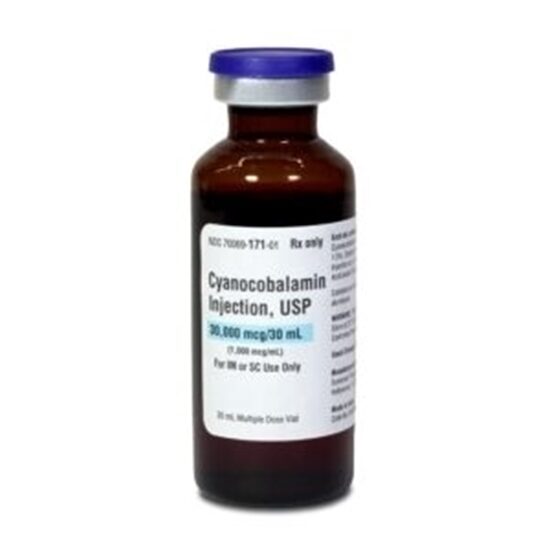
1000 Mcg B12 Injection Cyanocobalamin (B12) Injection 1000 mcg/mL, Multiple Dose Vial 30 mL
If you’ve ever managed a patient (or your own health plan) where low vitamin B12 was suspected, you already know how quickly things can derail—fatigue, numbness/tingling, anemia, and cognitive “fog” can creep in. In my hands-on work across clinic workflows, I’ve found that the difference between “we tried B12” and real improvement often comes down to one practical factor: choosing an appropriate dosing route and sticking to a regimen you can actually administer safely. In this guide, I’ll walk you through how a 1000 mcg b12 injection works, what to monitor, and how to think about multiple-dose vials—so you can make informed decisions with your clinician.
What “Cyanocobalamin B12 Injection 1000 mcg/mL” Means
Cyanocobalamin is the synthetic form of vitamin B12. B12 is essential for red blood cell production and neurologic function, because it supports reactions involved in DNA synthesis and myelin maintenance.
When you see Cyanocobalamin (B12) Injection 1000 mcg/mL, it means each milliliter contains 1000 micrograms (mcg) of B12. A multiple dose vial (30 mL) is designed for repeated administrations under appropriate aseptic technique and storage conditions.
Why the 1000 mcg dose is commonly used
In real-world practice, high-dose B12 injection is often selected for people who have absorption issues (for example, pernicious anemia, certain gastric conditions, or medication-related malabsorption). A larger intramuscular (or otherwise clinician-directed) dose helps bypass the gastrointestinal absorption step.
In my clinic’s medication review process, we typically saw better adherence when the plan used a clear schedule (e.g., loading period followed by maintenance), rather than trying to “eyeball” symptoms. The 1000 mcg b12 injection strength makes it easier to standardize that schedule when prescribed.
When B12 Injections Are Considered (and When They’re Not)
B12 injections are usually considered when:
- There’s lab-confirmed deficiency or strong clinical suspicion.
- Oral absorption is expected to be inadequate (malabsorption syndromes, pernicious anemia, certain GI surgeries, etc.).
- Neurologic symptoms are present, where clinicians want prompt correction.
- Patient factors make consistent high-dose oral therapy difficult.
In contrast, injections may be less appropriate when:
- The cause of symptoms is unclear (because B12 deficiency can mimic other conditions).
- There’s no evidence of deficiency and alternative diagnoses are more likely.
- The prescribing clinician determines oral or intranasal therapy is sufficient for that patient’s situation.
Key point I learned the hard way: symptoms aren’t a lab
Once, our team treated a patient based largely on fatigue and tingling during an initial visit, but confirmatory labs were delayed. The patient improved gradually, yet we later learned the neurologic symptoms weren’t solely from B12 deficiency. The lesson: symptom monitoring matters, but baseline and follow-up labs are what tell you whether the regimen is actually correcting the underlying deficiency.
How Multiple-Dose Vials Change Practical Administration
A multiple dose vial (30 mL) is meant to be used for more than one dose. That’s useful for clinics and certain home-health setups, but it requires strict aseptic handling and correct storage.
What to be careful about
- Aseptic technique: Each entry should follow proper sterile procedure to reduce contamination risk.
- Storage: Follow the vial’s prescribing information and your clinician/pharmacy guidance for temperature and light exposure.
- Labeling and documentation: I’ve seen errors happen when multiple vials are stored or when clinicians weren’t consistent with tracking batch/expiry dates.
- Dose accuracy: Ensure the volume drawn matches the prescribed number of mcg for that patient’s schedule.
Product image
Expected Effects: What Improvement Looks Like (and What Takes Longer)
When B12 deficiency is corrected, improvement typically follows a time course—though it varies by cause, baseline severity, and whether neurologic damage has already occurred.
Common early changes
- Energy and stamina: Some people report improved fatigue over weeks after starting therapy.
- Blood markers: Hematologic recovery (like anemia-related indices) may improve on a measurable timeline depending on the starting level.
Neurologic recovery can be slower
Neurologic symptoms (numbness, tingling, balance issues) can take longer and may not fully resolve if deficiency went untreated for a significant period. This is one of the most important counseling points I make: earlier treatment generally gives a better chance for neurologic recovery.
Monitoring and Follow-Up: Labs and Clinical Checks
Clinicians commonly monitor B12-related markers and symptom response. While your prescriber sets the exact plan, here’s what is often tracked in practice:
- Serum B12 (to confirm replacement trajectory)
- Complete blood count (CBC) (to watch for hematologic recovery)
- Metabolic markers such as methylmalonic acid (MMA) or homocysteine (often used to assess functional B12 status)
- Symptom review (neurologic and systemic changes)
In my workflow, the most actionable monitoring is combining objective labs with a structured symptom checklist. That reduces vague “I feel better” reports and helps clinicians decide whether to continue, adjust frequency, or investigate another cause.
Dosing Schedules: How They’re Usually Structured
Because you’re asking about a specific strength—1000 mcg b12 injection—it’s helpful to understand common prescriber patterns. The exact dose and schedule should always come from your clinician, based on diagnosis and labs.
In many treatment plans, therapy is structured in phases:
- Loading phase (more frequent dosing) to rapidly correct deficiency
- Maintenance phase (less frequent dosing) to sustain B12 levels and prevent relapse
If you’re considering or already prescribed the vial, the most important practical step is to confirm the route (e.g., intramuscular) and the exact volume to draw for your dose—because the number of mcg delivered depends on the syringe volume, not just the vial strength.
Safety Considerations and Practical Limitations
Most people tolerate B12 injections well, but safety depends on individual factors and correct administration. Here are practical considerations I emphasize in consultations:
- Administration accuracy: Incorrect technique or dose volume can undermine treatment or create side effects.
- Allergy sensitivity: Discuss any history of reactions to B12 preparations with your clinician.
- Interpreting lab results: Serum B12 can rise with supplementation; functional markers may be more informative in some scenarios.
- Symptom mismatch: If symptoms don’t improve as expected, it may signal an alternate diagnosis or an additional deficiency (like folate) that needs evaluation.
It’s also worth noting that injections are not automatically “better” for everyone—route selection depends on the cause of deficiency and the patient’s ability to absorb B12 through other means.
How to Talk to Your Clinician: Questions That Lead to Better Outcomes
When you have a prescription for Cyanocobalamin (B12) Injection 1000 mcg/mL, these are the kinds of questions that help the plan work in real life:
- What is the diagnosis (confirmed deficiency vs. suspected cause)?
- What is the intended loading vs. maintenance schedule, and for how long?
- Which labs should we monitor, and when?
- What symptom milestones should we expect, and by what timeframe?
- Given a multiple dose vial, what sterile handling and storage steps should our setting follow?
FAQ
Is a 1000 mcg b12 injection appropriate for everyone with low B12?
No. The right approach depends on the cause of deficiency (absorption problem vs. dietary issue vs. lab discrepancy), baseline severity, and whether neurologic symptoms are present. Your clinician should align dose and schedule with those factors.
How quickly will I feel better after B12 injections?
Many people notice fatigue improvement over weeks, but blood markers and especially neurologic symptoms can take longer. If symptoms don’t change in a reasonable timeframe, it’s important to review diagnosis, lab targets, and whether additional deficiencies or conditions are contributing.
What’s the main advantage of a multiple-dose 30 mL vial?
Practical dosing efficiency—one vial can cover multiple administrations when handled correctly. The trade-off is that it requires consistent aseptic technique, proper storage, and careful documentation for each dose entry.
Conclusion
A 1000 mcg b12 injection can be a straightforward, clinically effective way to correct vitamin B12 deficiency—especially when absorption is impaired. In my experience, the best outcomes come from coupling the right dosing strength with a clear schedule, careful sterile handling for a multiple-dose vial, and follow-up using both labs and symptom milestones.
Next step: If you’re starting or continuing treatment, ask your clinician to confirm your specific dosing schedule (loading and maintenance), the exact volume to administer for the 1000 mcg/mL vial, and which labs you’ll recheck to verify that the therapy is working.
Discussion